Your stress isn't
a character flaw.
It's a design problem.
Science-backed philosophy on stress regulation, decision clarity, and high-performance calm — for ambitious people who refuse to choose between achievement and their nervous system.
One weekly insight. No spam. Unsubscribe anytime.
Nervous System Debt
The accumulated physiological cost of chronic high-performance. It compounds like financial debt — invisibly, until it can't.
Control Theater
The elaborate rituals ambitious people perform to manage outcomes that were never actually within their control.
Ambition Masking Anxiety
The most socially celebrated form of anxiety disorder. Same cortisol signature. Different LinkedIn bio.
Vigilance Hangover
The day-after exhaustion from sustained high-alert performance. Your nervous system sends the bill on Thursday.
Explore what matters to you
Read the Essays
Science-backed analysis of stress, rest, and the optimization trap.
Browse Essays →Take an Assessment
Ten research-grounded tools to measure what your productivity app won't.
Explore Tools →Get the Newsletter
One weekly insight on nervous system regulation. No spam.
Subscribe Free →Start Learning
Guided paths that combine reading and self-assessment.
Explore Paths →Featured Essays
What Layoffs Do to the Person Who Made the Decision
The research on layoffs is almost entirely about the people who stay. Moral residue names what remains in the person who decided, and nobody studies it.
Read Essay →Why Selling Your Company Can Feel Like Losing Yourself
Post-exit emptiness is not ingratitude. The company was doing regulatory and identity work on your behalf, and the sale removes both at once.
Read →The Final-Say Tax: Why Deciding Costs More Than the Work
The cost is not how many decisions you make. It is being the person they stop with. The research on accountability asymmetry and cognitive fatigue.
Read →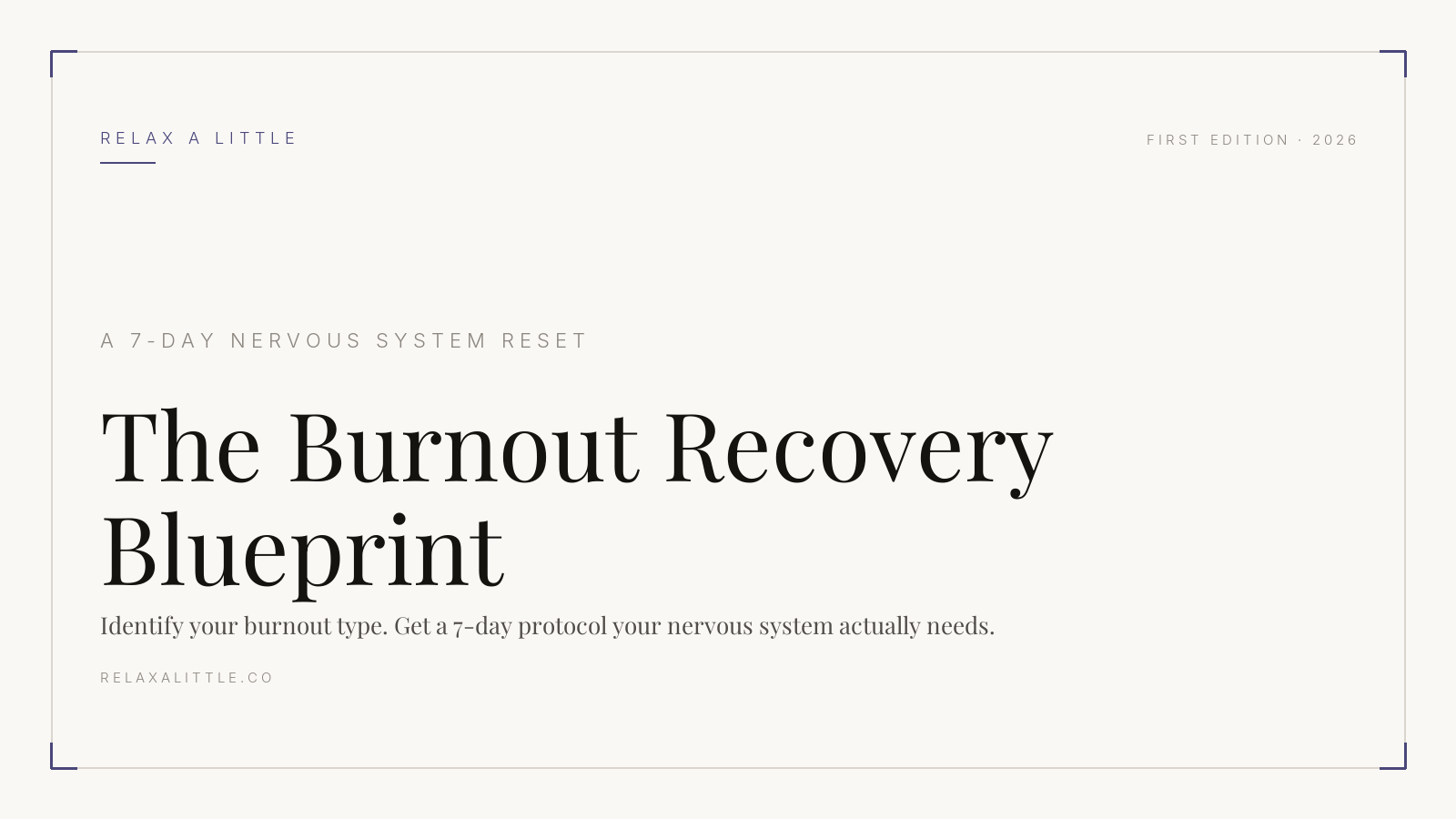
The Burnout Recovery Blueprint
A clinically grounded self-assessment that maps you to one of six burnout profiles, then gives you a 7-day protocol matched to the specific kind of rest your nervous system is missing. Built on Maslach, Dalton-Smith, and Porges — every action cited.
The failure isn't personal.
The environment is broken.
Your stress, burnout, and anxiety? That's a nervous system doing exactly what it was designed to do — in an environment it was never designed for.
We bridge neuroscience and real life. No mantras. No performance theater. Just rigorous science and what it means for your decisions.
Science-Backed
Every claim references peer-reviewed research. Not opinions dressed as facts.
For High Performers
Built for people who need evidence, not mantras. Skeptics welcome.
Intellectually Honest
We critique hustle culture AND wellness culture. Independent conviction.
Practically Useful
Understanding your system changes everything. This is the manual.
Six concepts that will
change how you read yourself
Nervous System Debt
The accumulated physiological cost of chronic performance. Like financial debt, it compounds invisibly. Unlike financial debt, no one teaches you to track it.
Control Theater
Elaborate rituals designed to manage outcomes that were never actually within your control. It feels like productivity. It is anxiety with better aesthetics.
Ambition Masking Anxiety
The most socially celebrated neurological profile on earth. Same cortisol signature as clinical anxiety. Different LinkedIn tagline.
Vigilance Hangover
The day-after cost of sustained high-alert performance. Your nervous system spent 10 hours in threat-detection mode. The invoice arrives Thursday morning.
Performance Identity Collapse
The existential crisis when achievement-based identity can no longer perform. The most dangerous moment for a high achiever isn't failure. It's hollow success.
The Optimization Trap
You cannot optimize your way out of a dysregulated nervous system. The optimization IS the dysregulation. This is the trap most high performers spend a decade inside.
Frequently Asked Questions
What is Relax A Little?
Relax A Little is a science-backed publication that uses neuroscience and behavioral science to challenge optimization culture. We prove that strategic rest, not more productivity tools, is what high performers actually need to recover clarity, creativity, and autonomy.
What are the symptoms of burnout?
Burnout produces three measurable dimensions of symptoms, not a single feeling. Christina Maslach’s research identifies emotional exhaustion (chronic depletion that sleep does not fix), depersonalization (cynicism and detachment from work and people), and reduced personal accomplishment (feeling ineffective despite output). Most people experience exhaustion first, then cynicism as a coping response. Physical symptoms include disrupted sleep, frequent illness, and difficulty concentrating. If two or more dimensions are elevated, you are not just tired.
What is the difference between stress and burnout?
Stress is acute and time-limited. Burnout is chronic and structural. Bruce McEwen’s allostatic load research shows that stress activates the HPA axis temporarily and resolves with rest, while burnout reflects systemic adaptation: persistent cortisol dysregulation, prefrontal cortex thinning, and depleted recovery capacity. The clearest test is whether a vacation restores you. Stress responds to rest. Burnout requires structural change to the demands creating it.
How long does burnout recovery take?
Burnout recovery typically takes three months to over a year depending on severity. A 2021 study in the Journal of Occupational Health Psychology found meaningful improvement required at least ten weeks of sustained effort, including active nervous system regulation and cognitive load reduction, not just passive rest. Severe burnout with physical symptoms can require twelve to eighteen months. Recovery is not linear, and early returns to high workload commonly trigger relapse.
What is nervous system regulation?
Nervous system regulation is the process of returning your autonomic nervous system to a balanced state after stress activation. Techniques like cyclic sighing, cold exposure, and vagal toning help shift from sympathetic (fight-or-flight) to parasympathetic (rest-and-digest) dominance. Unlike productivity hacks, these interventions work with your biology rather than against it.
How do you regulate your nervous system?
Nervous system regulation works by activating parasympathetic dominance through specific physiological inputs. The most evidence-backed technique is cyclic sighing, validated in a 2023 Stanford study led by David Spiegel: two short inhales through the nose followed by a long exhale through the mouth, repeated for five minutes, lowers physiological arousal more than mindfulness or box breathing. Cold exposure, vagal toning, and restorative environments produce additional regulatory inputs.
What are the seven types of rest?
The seven types of rest were identified by Dr. Saundra Dalton-Smith and include physical, mental, sensory, creative, emotional, social, and spiritual rest. Each addresses a different recovery deficit. Most people default to physical rest (sleep) when their actual deficit is sensory or emotional, which is why "I rested all weekend and still feel exhausted" is common. The mismatch between your dominant deficit and your default recovery strategy is what keeps burnout in place.
Why do I feel guilty when I rest?
Rest guilt is a neurological response, not a character flaw. Sabine Sonnentag’s meta-analysis of 72 recovery studies found that workers conditioned to high arousal experience stillness as physiologically wrong, not restful. The anterior cingulate cortex learns to flag rest as a threat after years of achievement-based reinforcement. Standard advice to "just relax" fails because it ignores the mechanism. The fix is structural: schedule rest and remove productivity triggers from your environment.
Are sleep trackers bad for sleep?
Sleep trackers can cause the disorder they claim to measure. Kelly Glazer Baron’s research at Rush University coined the term orthosomnia for patients whose normal polysomnography results were contradicted by anxious wearable scores, producing real insomnia from the monitoring itself. Evaluating your HRV score activates prefrontal threat-detection cycles that generate the arousal sleep tracking was supposed to prevent. The diagnostic question is whether your tracker reduces your sleep anxiety or generates it.
Is it possible to be too productive?
Yes. Research on the optimization paradox shows that beyond a threshold, additional effort produces diminishing and then negative returns. A Stanford study found productivity per hour drops sharply after 50 hours per week. The pursuit of maximum output often creates the burnout, decision fatigue, and chronic stress it was supposed to prevent.
Your nervous system has been
running on borrowed time.
One research-backed insight per week on stress regulation, decision clarity, and the neuroscience of doing less — without the guilt trip.
No spam. No fluff. Unsubscribe anytime.